The Evolutionary Blueprint of the Domestic Cat
The domestic cat, Felis catus, presents a captivating blend of social companion and instinct-driven predator. Despite centuries of cohabitation with humans, the behavior of the house cat remains genetically and behaviorally tied to its solitary wild ancestors. Many of the behaviors pet owners commonly label as “strange,” “malicious,” or “random” are, in fact, highly rational and critically important instinctual responses that have been adapted—or, in some cases, misapplied—to the modern domestic setting.
Interpreting feline behavior requires a rigorous ethological approach that moves beyond simple anthropomorphism. Understanding why a cat acts as it does demands an analysis of its fundamental drives: the inherent predatory sequence, the non-negotiable requirements for territorial security, and the evolved mechanisms for energy conservation. This report aims to interpret the most common feline eccentricities by examining the underlying psychology and instinctual motivations that govern the domestic cat’s daily actions.
Part I: The Case of the Counter-Clearer: Object Manipulation and the Prey Drive
The behavior of intentionally knocking objects off tables, counters, or shelves is perhaps the most vexing of feline habits. This action is not a random expression of spite; rather, it is a complex intersection of the cat’s need for physical engagement, its learning capacity, and its deep-seated predatory instincts.
1. The Instinctual Bat: Movement, Sensation, and the Predatory Trigger
At its core, object manipulation appeals directly to the cat’s hardwired predatory blueprint. As obligate predators, cats are highly attracted to objects that dart past their line of sight, viewing fast-moving stimuli as potentially chaseable, catchable prey. The simple act of batting an object closer to an edge or knocking it to the floor fulfills this fundamental need for interaction with a dynamic environment.
When an item falls, it creates immediate sensory feedback—auditory (the crash or rattle) and visual (the object rapidly moving away)—which mimics the struggle or flight of a captured animal. This movement triggers the instinctual “catch and kill” sequence. Furthermore, the use of the paw to push objects is a form of tactile exploration. Cats use their paws to gather information, testing if potential prey is alive or if an unfamiliar object is secure, satisfying their need for sensory engagement.
2. Attention Economy: Analyzing Reinforced Behavior
While the behavior may start as ethological exploration, it quickly transitions into a psychological mechanism driven by learning theory. Domestic cats are remarkably adept at forming associations. If the action of knocking an object over reliably elicits a high-value resource, such as attention or interaction from their human companion, the action is powerfully reinforced.
The subtlety of reinforcement is often missed by owners. Attention is not exclusively positive; it includes any form of response. Negative attention—such as yelling, a sharp gasp, or rushing to pick up the cat—is still a response that fulfills the cat’s desire for engagement. Even a slight glance toward the cat while it bats an item is sufficient reinforcement to cement the behavior. The analysis suggests that while the behavior originates from the innate prey drive, the auditory and visual reward quickly becomes secondary to the social reward. When the owner’s predictable reaction proves to be a more valuable resource than the original prey stimulus, the cat learns that manipulating objects is a high-success strategy for securing interaction or mitigating loneliness. This elevates the behavior into a form of social demand. Moreover, if the owner replaces the item immediately, they grant the cat another immediate opportunity to repeat the success, further strengthening the undesirable habit.
The mechanism for cementing this attention-seeking behavior can be understood as a consistent loop of rewarding action:
The Reinforcement Cycle: Knocking for Attention
| Step in Cycle | Cat’s Action (Cause) | Owner’s Typical Reaction (Reinforcement) | Resulting Behavioral Learning (Effect) |
| 1. Initiation | Bats item to the edge or off the surface. | Looks directly at the cat, gasps, or speaks (high-intensity attention). | Attention is received, stimulating the cat’s need for engagement (Positive Reinforcement). |
| 2. Execution | Item falls and makes a noise/owner rushes over. | Picks up the cat, replaces the item, or cleans up the mess (Interaction). | The cat achieves its goal: interaction/stimulation. The cycle closes successfully. |
| 3. Repetition | Cat seeks out new objects or repeats the act frequently. | The cat learns that object manipulation is the most successful, guaranteed strategy to elicit a response from its human. | The undesirable behavior is cemented as a successful, high-priority strategy. |
3. Environmental Deficiency and Boredom as the Root Cause
Boredom is identified as a major trigger for destructive object manipulation. Cats who exist in environments lacking appropriate stimulation—such as insufficient vertical territory, scratching opportunities, or interactive toys—will inevitably find ways to entertain themselves.
For a cat left alone for prolonged periods with little to do, the activity of propelling things off surfaces may be the most exciting physical and mental exercise available all day. Environmental enrichment is therefore a critical intervention for curbing this behavior. The need for physical activity and mental novelty is so intense that the cat will resort to destructive behavior to satisfy this fundamental requirement.
Part II: Territory, Trust, and the Language of Scent
Certain rhythmic and seemingly unusual behaviors, such as kneading and bunting, are central to the cat’s communication system. These actions are complex expressions of emotional state, security, and chemical communication (olfactory signaling).
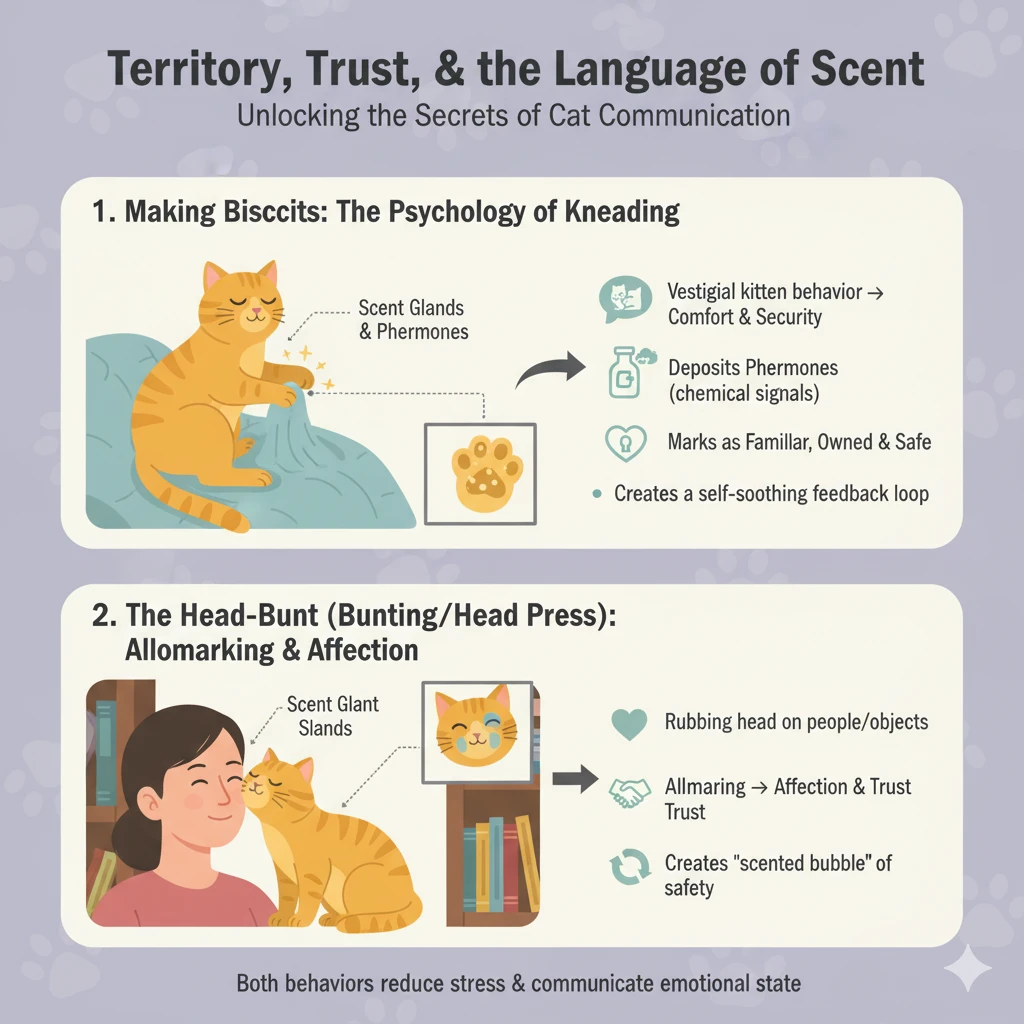
1. Making Biscuits: The Psychology of Kneading
Kneading, often colloquially termed “making biscuits,” is the rhythmic alternation of pushing paws into a soft surface. This action originates directly from kittenhood, where the motion pressed against the mother’s mammary glands stimulated milk flow. As a vestigial behavior, it persists into adulthood, associated with the profound feelings of security and contentment experienced during nursing. Consequently, kneading often signals deep trust and relaxation when a cat is lying on an owner’s lap or a favorite blanket.
However, kneading is not solely a comfort mechanism; it serves a crucial chemical function. Cats possess specialized interdigital scent glands located between their toe pads. The rhythmic action of kneading deposits pheromones—chemical signals invisible to humans but highly communicative to other felines—onto the surface. By depositing this unique scent signature, the cat marks the object or person as familiar, owned, and safe. This behavior reinforces their sense of ownership and safety within their environment.
This linkage between tactile comfort and olfactory comfort is critical: the physical act (kneading) triggers the release of reassuring chemicals (pheromones). The motor activity originally tied to nutrition is repurposed to establish a positive, self-soothing feedback loop, which sets the context of the location or person as secure and owned.
2. The Head-Bunt (Bunting/Head Press): Allomarking and Affection
Bunting, or head-pressing, involves rubbing the head against a person or object. This releases pheromones from large sebaceous glands located on the cheeks, chin, and forehead. When directed toward humans or other trusted companion animals, bunting is known as allomarking, serving as a profound signal of affection and trust, strengthening the human-cat bond.
The function of scent marking in the domestic environment shifts from territorial exclusion to psychological inclusion. By incorporating the human into its established “safe zone” through scent-marking, the cat reinforces its security. This action of creating a ‘scented bubble’ directly reduces perceived environmental stress and fills the cat’s senses with markers of safety and contentment. Therefore, both kneading and bunting are sophisticated, instinctual coping mechanisms used by the cat to manage its environment and communicate its emotional state.
Part III: High-Octane Expressions: Energy Release and Predatory Frustration
Feline behavior often includes explosive bursts of energy and idiosyncratic vocalizations. These behaviors are directly linked to the cat’s predatory scheduling and physiological needs for energy discharge.
1. Frenetic Random Activity Periods (FRAP): The Science of the Zoomies
Frenetic Random Activity Periods (FRAP), universally known as “zoomies,” are spontaneous, high-speed movements often accompanied by excited vocalizations, darting, and leaping. FRAP is a completely natural and healthy expression of accumulated, unused energy and hunting instincts.
Cats are evolved for short, intense bursts of activity required for hunting, followed by prolonged periods of rest necessary for energy conservation. When a cat accumulates too much energy without an appropriate outlet during the day, FRAP acts as a mandatory physiological discharge. The frequency and timing of FRAP, especially if they occur frequently at night, serve as diagnostic indicators of insufficient daily stimulation. If energy is consistently released at inappropriate times (e.g., nocturnal zoomies when the owner is asleep), it signals that the cat’s essential need for physical activity and mental stimulation during its peak waking hours has not been adequately met. Managing FRAP successfully therefore requires scheduling intensive, structured play that satisfies the full predatory sequence (stalk, chase, pounce, capture).
FRAP is also commonly observed immediately following the use of the litterbox. This post-elimination dash is thought to be a sign of relief and freedom after successfully eliminating waste, or an expression of satisfaction linked to the cat’s natural desire for cleanliness. In multi-cat households, it can also function as a quick, brief territorial display.
2. Chattering and Chirping: The Unattainable Prey
Feline chattering—a rapid, jaw-quivering vocalization—is a complex behavior deeply rooted in the cat’s instincts, providing a direct link between domestic cats and their wild ancestors. This behavior signifies extreme excitement, anticipation, and a state of heightened alertness, typically triggered by the sight of potential prey, such as birds or insects.
Chattering and chirping are most often observed when the cat is fixated on prey that is inaccessible, such as through a closed window. This circumstance strongly supports the frustration hypothesis. The vocalization is hypothesized to be a displacement activity—an involuntary release of tension arising from the internal conflict between the intense drive to hunt and the physical barrier preventing the completion of the predatory sequence. When observing prey, the cat may freeze, fixated on the target while rapidly calculating the optimal approach for an attack. Chattering serves as the necessary outlet for the resulting high state of arousal. It signifies an internal conflict between extreme motivational drive and the cognitive awareness of a physical barrier.
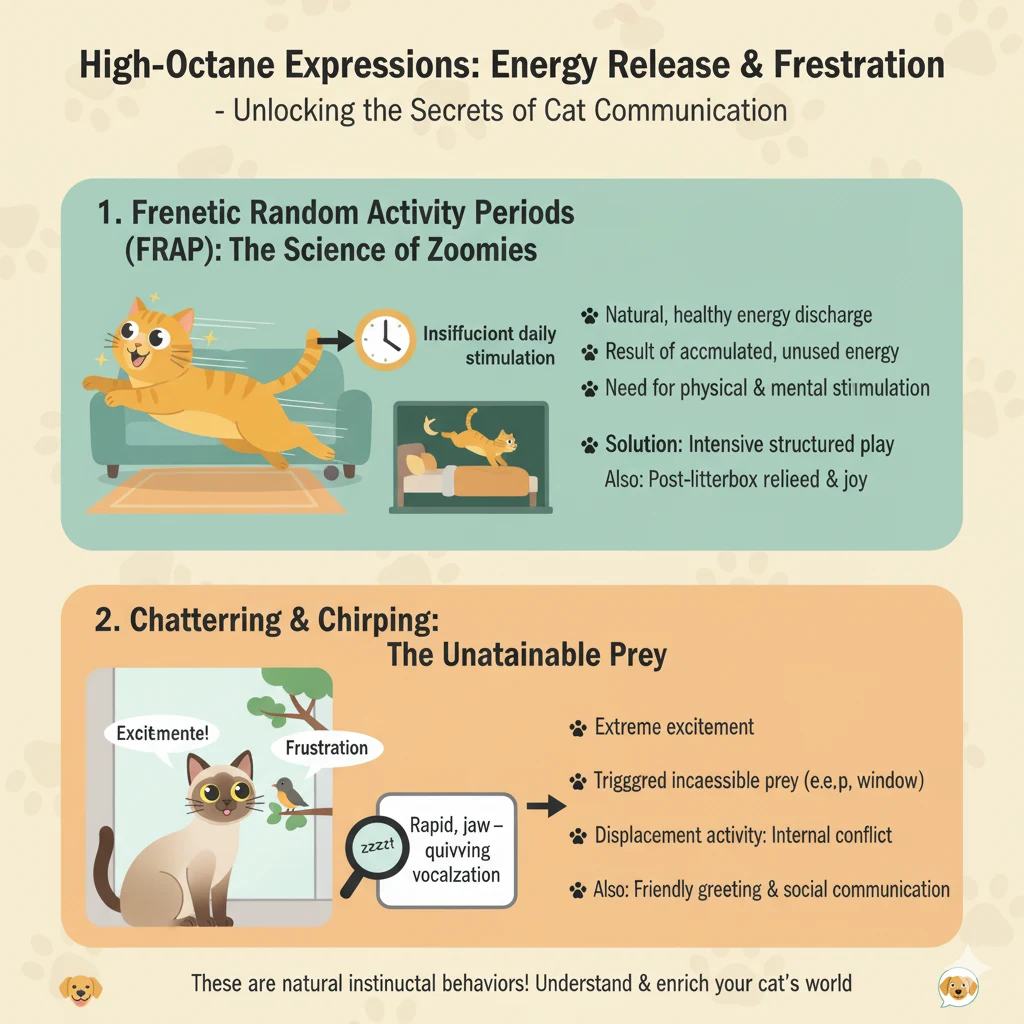
Beyond frustration, chirping is also utilized as a form of social communication. It is frequently employed as a friendly greeting directed at humans and is sometimes used to seek attention or express excitement to companions.
Part IV: The Instinctual Search for Security and Survival
Certain peculiar preferences, such as the cat’s obsession with confined spaces and its paradoxical relationship with water, are firmly rooted in ancient self-protection and health preservation strategies.
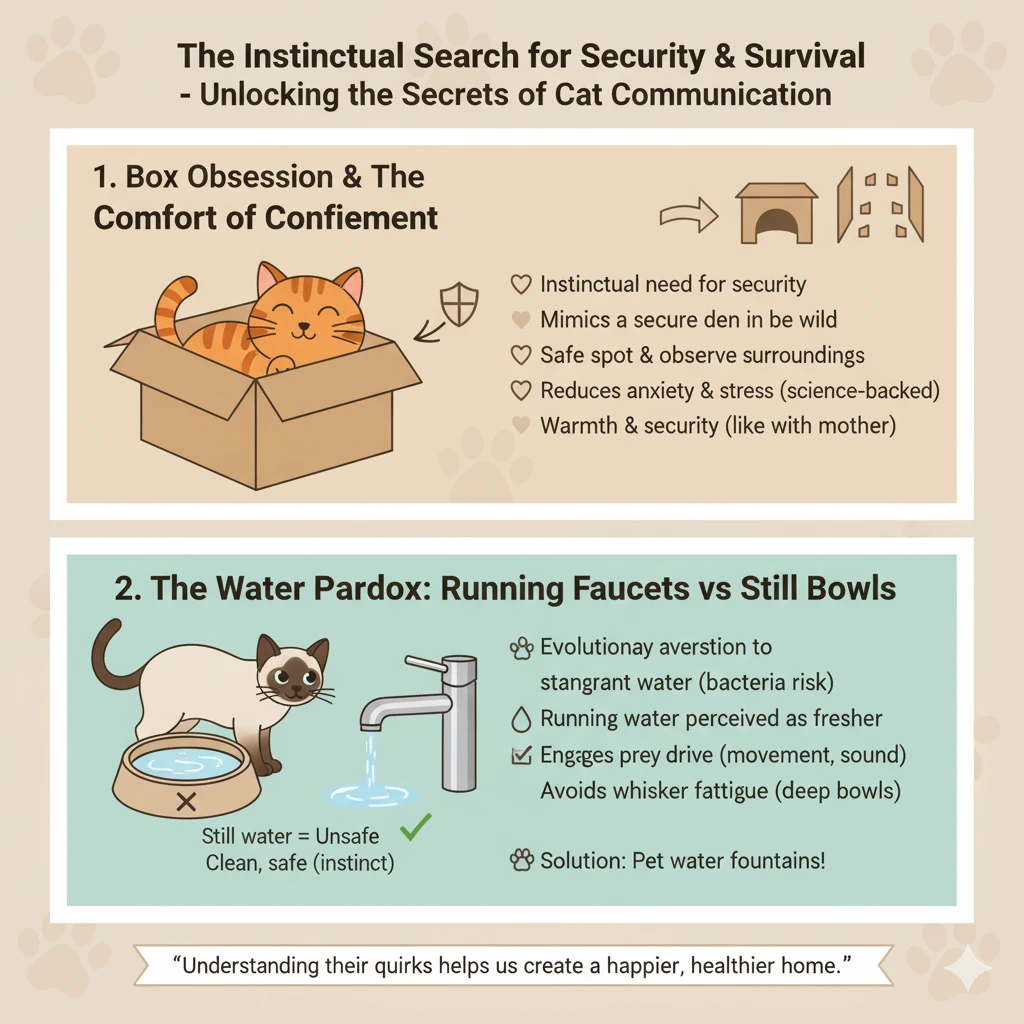
1. Box Obsession and the Comfort of Confinement
The preference for cardboard boxes and other small, enclosed spaces is powerfully driven by instinct. These tight quarters mimic a secure den or burrow in the wild. For an animal that is both a predator and vulnerable to larger threats, a box offers unmatched security. It allows the cat to safely observe its surroundings while ensuring it cannot be approached from behind or the sides. This provision of a reliable retreat is a critical component of feline psychological safety, serving to reduce anxiety and stress.
Research indicates that cats with constant access to secure hiding spaces exhibit lower overall stress levels. The sensation of being enclosed triggers a sense of warmth and security, psychologically akin to the feeling kittens experience when nestled securely with their mother and siblings. This suggests that the box is not merely a quirk; it is vital infrastructure for coping and adapting to new or stressful environments. Furthermore, boxes satisfy the cat’s hunting instinct by providing the ideal concealed spot to wait and launch an ambush, reinforcing natural behaviors.
2. The Water Paradox: Running Faucets vs. Still Bowls
The seemingly contradictory behavior of avoiding baths yet being mesmerized by a dripping faucet is explained by evolutionary drivers related to survival and health. Cats possess an instinctive aversion to still or stagnant water because, in the wild, this water source carries a high risk of contamination from bacteria, viruses, or microbes. This instinct is a key survival mechanism, reducing the risk of waterborne illnesses such as leptospirosis, which is often contracted via contaminated still water.
Conversely, running or moving water, like that from a stream or a faucet, is evolutionarily deemed fresher, cleaner, and therefore safer. This perception overrides the general feline aversion to getting wet. For a species that originated in arid environments and often has a relatively low thirst drive, the quality of the water source is a crucial determinant of hydration. If a cat’s instinct tells it that its still water source is unsafe or chemically unappealing, it may dangerously limit its fluid intake. Utilizing technology like pet water fountains addresses this ancient survival concern, thereby mitigating modern-day health risks linked to chronic dehydration.
Beyond the evolutionary cleanliness factor, running water also engages the cat’s senses. The movement, reflection, and noise activate the cat’s prey drive, making the water source intriguing and fun to interact with. Additionally, the use of a deep, standard bowl can cause physical discomfort known as whisker fatigue, where repeated contact with the bowl edge over-stimulates the highly sensitive vibrissae. Running water sources often allow the cat to drink without this direct whisker contact.
Part V: Applied Ethology: Management and Environmental Enrichment
A nuanced understanding of feline psychology translates directly into effective management strategies. By aligning the domestic environment with the cat’s ancestral instincts, owners can proactively address the root causes of disruptive behavior.
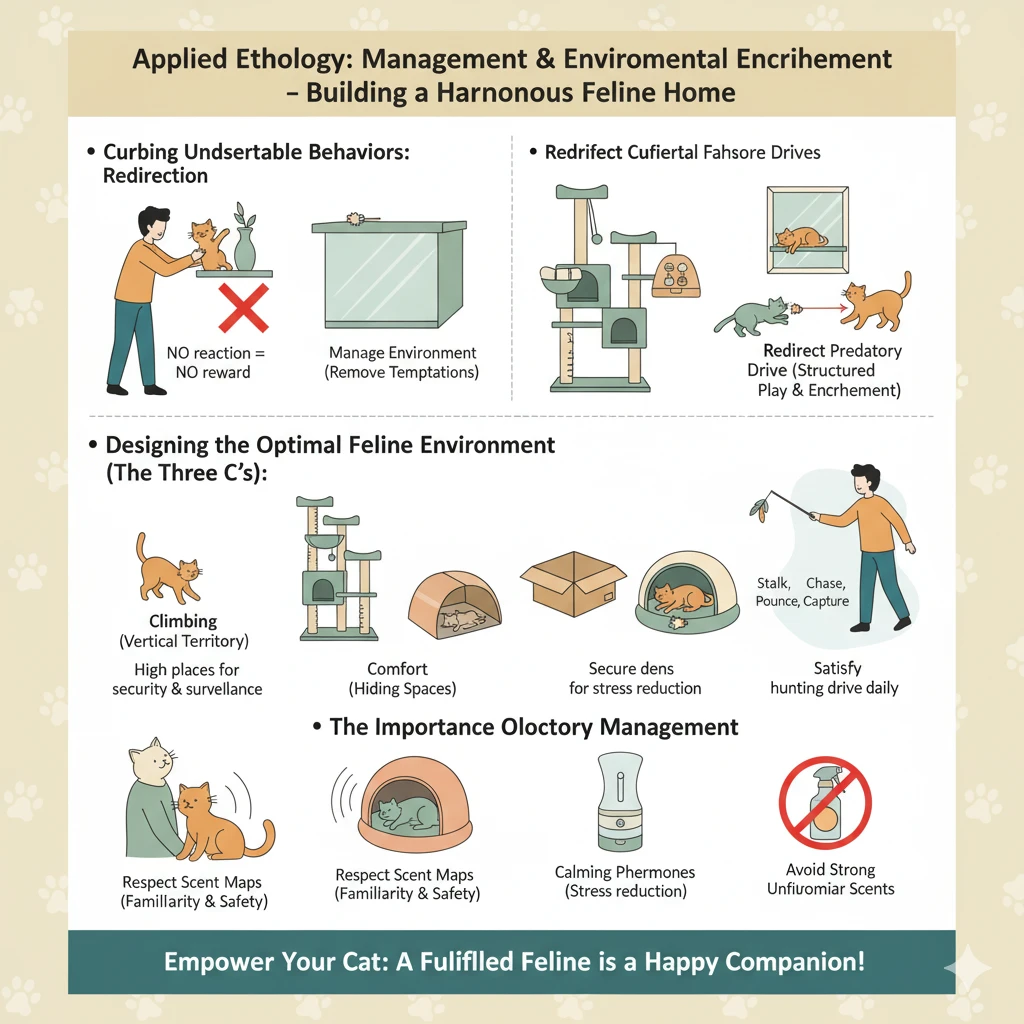
1. Curbing Undesirable Behaviors: Strategy for Redirection
The primary strategy for eliminating object manipulation is to break the reinforcement cycle identified in Part I. Owners must commit to providing a neutral response—or, optimally, no response at all—to attention-seeking destructive acts. Any vocalization or rushing over, even in frustration, functions as a high-value reward. Simultaneously, the environment must be managed: removing irresistible and fragile items from tempting surfaces prevents the opportunity for the behavior, extinguishing the habit through lack of reinforcement.
Behavioral management must include redirecting the intense predatory drive toward sanctioned activities. Boredom and unused energy are the primary motivators for two of the most complained-about behaviors (knocking and zoomies). Therefore, the highest priority is providing robust environmental enrichment and targeted predatory play. This includes high-quality wand toys, food puzzles that simulate hunting challenges, and structured playtime that ensures the cat successfully completes the predatory sequence (capture and simulated kill).
2. Designing the Optimal Feline Environment (The Three C’s)
Effective environmental management revolves around meeting the ethological requirements of the cat.
A/Climbing (Vertical Territory)
Cats require high, vertical territory, such as cat trees, shelving, and window perches, to satisfy their instinctual need for security and surveillance. Elevated spaces allow the cat to observe its domain from a secure vantage point, reducing perceived stress from low-level activity.
B/Comfort (Hiding Spaces)
The provision of secure, confined hiding spots (boxes, covered beds, dens) is essential for facilitating stress reduction and ensuring psychological safety. Integrating these features is particularly important during periods of household change or stress.
C/Catch (Hunting Simulation)
Regular, structured play sessions must be implemented that allow the cat to successfully complete the full sequence of hunting behavior. This sustained interaction adequately expends the energy that would otherwise lead to nocturnal FRAP or destructive, attention-seeking behaviors.
3. The Importance of Olfactory Management
The emotional significance of scent marking—kneading and bunting—cannot be overstated. These behaviors establish a vital ‘scent map’ of safety and ownership. Owners should be mindful of aggressive cleaning protocols or the introduction of strong, unfamiliar scents that could override the cat’s crucial security markers. Respecting these scent-based expressions reinforces the cat’s sense of territorial familiarity. In environments of high stress, supplemental resources such as synthetic calming pheromones (analogs of natural feline facial pheromones) can be used to further enhance the feeling of safety and confidence within the established territory.
Conclusion: Harmonizing the Wild and the Domestic
Feline “quirks” are revealed to be logical, data-driven behaviors stemming from the cat’s unique evolutionary position as a solitary hunter living in a resource-rich, social domestic setting. The behaviors observed are not acts of defiance, but necessary functions of survival, communication, and energy regulation.
The comprehensive analysis of feline motivation reveals that object knocking and nocturnal zoomies are often symptomatic of a single underlying condition: a failure to meet the cat’s intense, physiological need for mental engagement and physical expression of the predatory drive. Similarly, the preference for boxes and running water are sophisticated survival strategies adapted to the management of stress and the avoidance of contamination risk.
The truly expert companion is one who transitions from asking, “Why are they doing that?” to inquiring, “What instinctual need is that behavior satisfying?” This shift in perspective allows for proactive, informed companionship, transforming seemingly strange behaviors into actionable cues that enhance the cat’s welfare and ensure a harmonious environment.
Feline Behavior Decoded: Motivation and Management
| Behavior | Primary Instinctual/Psychological Driver | Management/Redirection Strategy |
| Knocking Objects | Predatory Drive, Boredom, Attention-Seeking (Reinforcement) | Environmental enrichment (vertical space), scheduled intensive play, immediate non-response to the destructive act. |
| Kneading & Bunting | Comfort, Security, Territorial Marking (Pheromones), Affection | Accept the marking; reinforce the sense of safety; provide soft surfaces for kneading; maintain calm routines. |
| Zoomies (FRAP) | Energy Release, Hunting Instinct | Scheduled high-intensity play to preempt bursts; increase mental stimulation; ensure appropriate climbing opportunities. |
| Chattering/Chirping | Excitement, Hunting Frustration (Displacement Activity) | Provide alternative toys or redirect focus; understand this is a sign of intense, natural arousal. |
| Box/Confinement Use | Security, Stress Reduction, Den Mimicry | Ensure continuous access to multiple, appropriately sized hiding spots, especially during environmental change or stress. |
| Running Water Preference | Evolutionary Safety, Contamination Aversion (Instinct) | Utilize pet water fountains or ensure a wide, shallow bowl that minimizes whisker fatigue and frequent refreshing. |